Status
RECRUITMENT_OPEN
Capacity
NO_LIMIT
By clicking you agree to the terminal_user_agreement and mission_protocols.
Submit your project/video link using the Submit Project/Video button above.
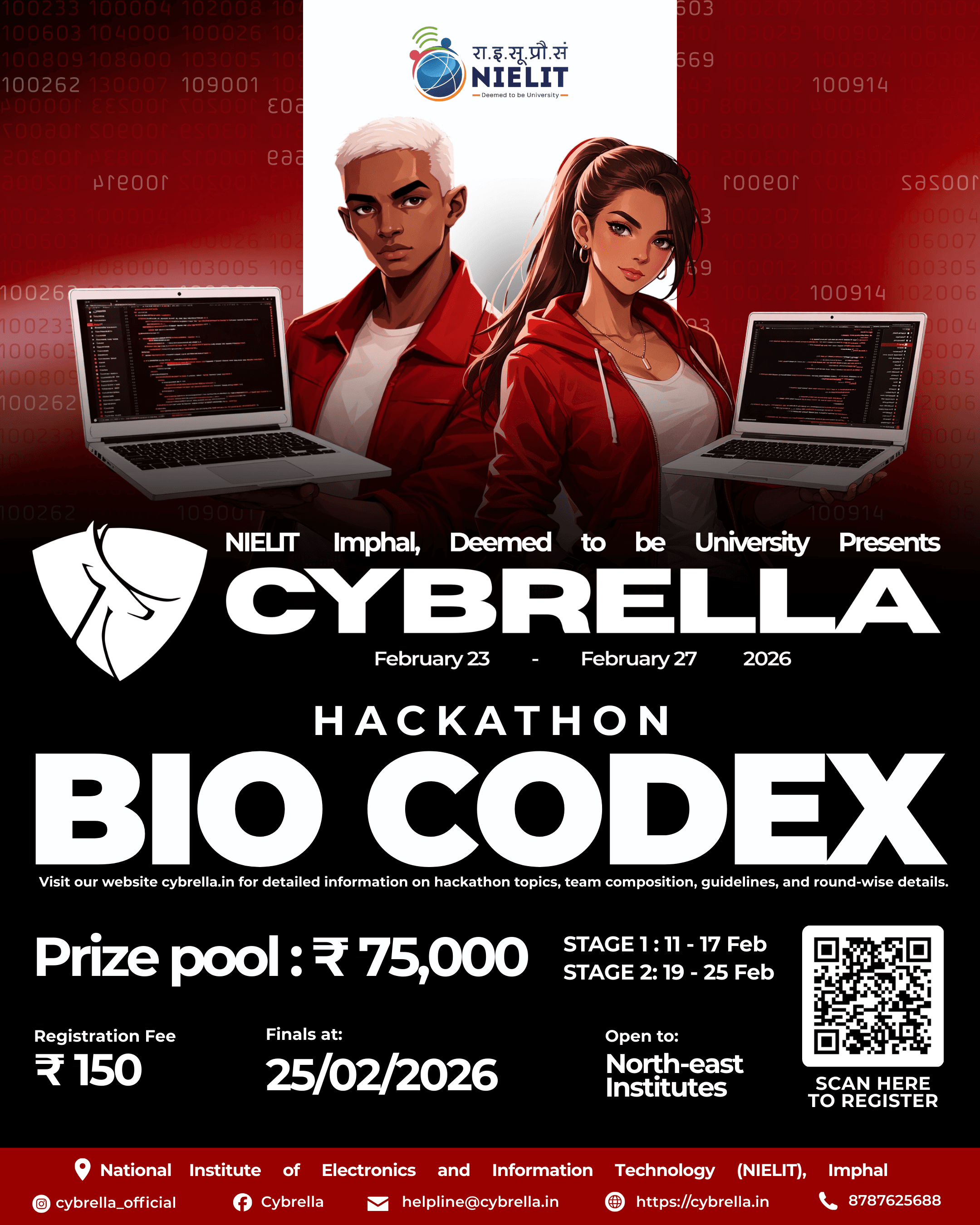
HACKATHON BIO CODEX
Prize_Pool_Authorized
75,000
// Rewards_Calculation: Based_on_participation_thresholds //
DATE_LOG
2026-02-25
CREDITS_REQUIRED
₹150
EXPECTED_REWARDS
75,000
REGISTRATION_CLOSES
2026-02-18
TOTAL_SLOTS
NO_LIMIT
Hackathon BioCodex 2026: Official Rules & Guidelines This document outlines the official rules, eligibility, and judging criteria for Hackathon BioCodex 2026. This year, the competition is divided into two distinct rounds to foster better project development and rigorous evaluation. 1. Competition Structure & Timeline The hackathon is split into a Qualifying Round and a Final Excellence Round. ● Round 1: The Qualifying Round (Feb 11th – 17th) ○ Focus: Ideation, Architectural Planning, and Initial Prototyping. ○ Hacking Period: Starts Feb 11th, 09:00 AM; Ends Feb 17th, 11:59 PM. ○ Submission Deadline: Feb 17th, 11:59 PM. ○ Judging Period: Feb 18th ○ Shortlist Announcement: Feb 19th, 09:00 AM. (Top teams advance to Round 2). ● Must Submit for Round 1: To be eligible for judging, teams must update their GitHub repository with the following and submit the GitHub Link via the official portal: ○ Problem Statement: A clear definition of the specific challenge being addressed. ○ Proposed Solution: A detailed description of how your hack intends to solve the problem. ○ Project Proposal: The full document (based on the provided template) including tech stack and roadmap. ○ Presentation Video: A brief video explaining the concept and planned architecture (Upload to YouTube/Drive and link in README). ● Round 2: The Final Excellence Round (Feb 18th – 25th) ○ Focus: Feature Completion, Refining UI/UX, and Final Demo. ○ Hacking Period: Feb 19th – Feb 25th, 11:59 PM. ○ Submission Deadline: Feb 25th, 11:59 PM. ○ Final Results Announcement: Feb 27th. ● Must Submit for Round 2: ○ Advancing teams must update their existing GitHub repository with the following: ○ Final Codebase: The complete, functional source code developed during the hackathon. ○ Final README: Updated documentation including setup instructions and a list of features completed. ○ Demo Video: A maximum 2-minute video showing the working prototype in action. 2. General Competition Rules ● Team Composition: Maximum of 4 team members. "Ghost members" (zero contribution) will be removed from certificates. ● Exclusivity: Organizers, judges, sponsors, and volunteers are ineligible to participate. ● The "Fresh Code" Rule: While you can utilize pre-existing ideas or open-source libraries, all core logic for the hackathon features must be written during the event dates. ● Open Source: Use of frameworks (React, TensorFlow, etc.) is encouraged. However, "pre-building" the specific project logic before Feb 11th is prohibited. ● Existing Projects: If adding to an existing repo, you MUST clearly document in the README which commits and features were created during the BioCodex 2026 window. 3. Submission & GitHub Requirements ● Teams must maintain a single GitHub repository for both rounds. ● Submission Link: Every round requires the submission of the GitHub URL to the BioCodex portal. ● Timestamp Integrity: Commits made after the deadlines (Feb 17th for Round 1; Feb 25th for Round 2) will not be considered by the judges. 4. Eligibility ● Open Entry: BioCodex is open to students, independent researchers, labs, and startups. ● Inclusion: We maintain a zero-tolerance policy for discrimination. All participants must adhere to our Code of Conduct. ● Certificate Eligibility: Participation certificates are awarded only to teams that successfully complete Round 1 and submit all required "Must Submit" items. 5. Judging Criteria ● The panel will evaluate projects based on four equally weighted pillars: ● Technology: Technical complexity and the difficulty of the problem tackled. ● Design: Intuitive interface and accessibility for the intended end-user. ● Completion: Execution of the "Proposed Solution" submitted in Round 1. ● Learning: The "growth curve" of the team in implementing new technologies. 6. What the Judges ARE NOT Looking For ● Messy Code: Logic and functionality outweigh "perfect" formatting. ● Pitching Skills: We value builders over "Shark Tank" style marketing. ● Unfinished Hacks: If your code is broken, submit it anyway. Explain your hurdles; judges value the "honest fail." 7. Disqualification ● Plagiarism or submitting work created entirely before Feb 11th. ● Harassment or unsporting behavior. ● Breaking the Code of Conduct. ● Editing of the codebase after the final submission deadline. Contact: For clarifications, contact the Cybrella organizing team via the official helpdesk: helpdesk@cybrella.in Hackathon Ideas 1. BIOINFORMATICS Idea: AI-Based Disease Gene Predictor ● Problem: Identifying disease-related genes is complex and time-consuming. ● Solution: Build an AI tool that analyzes DNA/RNA sequences to predict disease-causing genes. ● Features: ○ Upload gene sequence file ○ ML-based prediction ○ Risk score output ○ Visualization dashboard Idea: Drug Discovery Assistant ● Problem: Drug discovery is costly and slow. ● Solution: Use ML to predict drug–protein interaction. ● Features: ○ Molecular structure input ○ Binding affinity prediction ○ Drug ranking 2. BLOCKCHAIN Idea: Blockchain-Based Medical Record System ● Problem: Health records are insecure and fragmented. ● Solution: Store medical records securely using blockchain. ● Features: ○ Patient-controlled access ○ Tamper-proof storage ○ Smart contracts Idea: Anti-Counterfeit Medicine System ● Problem: Fake medicines cause serious health risks. ● Solution: Track medicines using blockchain QR codes. ● Features: ○ Scan & verify medicine ○ Supply chain tracking ○ Manufacturer validation 3. INFRASTRUCTURE Idea: Smart Traffic Management System ● Problem: Traffic congestion wastes time and fuel. ● Solution: Use AI + IoT to optimize traffic signals. ● Features: ○ Camera-based vehicle detection ○ Dynamic signal control ○ Real-time dashboard Idea: Structural Health Monitoring System ● Problem: Bridges/buildings may fail without warning. ● Solution: Monitor vibration and cracks using sensors. ● Features: ○ Sensor data analysis ○ Failure prediction ○ Alert system 4. HEALTH Idea: AI Health Diagnosis Chatbot ● Problem: Limited access to doctors in rural areas. ● Solution: Chatbot gives preliminary health advice. ● Features: ○ Symptom analysis ○ Risk prediction ○ Hospital locator Idea: Remote Patient Monitoring System ● Problem: Chronic patients need continuous monitoring. ● Solution: IoT-based wearable + app. ● Features: ○ Heart rate, BP tracking ○ Emergency alerts ○ Doctor dashboard 5. AGRICULTURE Idea: AI Crop Disease Detection System ● Problem: Farmers lose 20-40% of crops to diseases detected too late. ● Solution: Mobile app using computer vision to identify crop diseases from leaf images. ● Features: ○ Camera-based disease detection ○ Treatment recommendations ○ Disease outbreak mapping ○ Multilingual support for farmers Idea: Smart Irrigation System ● Problem: Water wastage in agriculture due to inefficient irrigation. ● Solution: IoT-based precision irrigation using soil moisture sensors and weather data. ● Features: ○ Soil moisture monitoring ○ Automated water pump control ○ Weather forecast integration ○ Water usage analytics Idea: Blockchain Farm-to-Consumer Traceability ● Problem: Consumers can't verify organic/quality claims; farmers don't get fair prices. ● Solution: Blockchain platform tracking produce from farm to table. ● Features: ○ QR code scanning for product history ○ Organic certification verification ○ Direct farmer-consumer marketplace ○ Transparent pricing Idea: AI-Powered Yield Prediction Platform ● Problem: Farmers struggle to predict harvest yields and plan sales. ● Solution: ML model predicting crop yields using satellite imagery, weather, and soil data. ● Features: ○ Satellite image analysis ○ Historical data processing ○ Yield forecasting ○ Market price recommendations BONUS: Hybrid Ideas Blockchain + Health + Bioinformatics Idea: Secure Genomic Data Sharing Platform ● Patients own their DNA data ● Blockchain for access control ● AI for disease prediction ● Hospitals & labs connect securely Agriculture + Blockchain + IoT Idea: Smart AgriChain Platform ● IoT sensors track crop growth conditions ● Blockchain records entire cultivation process ● AI predicts optimal harvest time ● Direct market linkage with verified quality Health + Agriculture + AI Idea: Nutrition-to-Farm Optimizer ● Analyzes patient nutritional needs (Health) ● Recommends local crops to grow (Agriculture) ● AI optimizes farm production based on community health data ● Connects farmers with healthcare institutions Project Proposal Template PROJECT TITLE: [Enter a concise, impactful title] Project Overview Team Name: [Your Team Name] Team Members: [Name] - [Role/Specialization] [Name] - [Role/Specialization] [Name] - [Role/Specialization] [Name] - [Role/Specialization] Mandatory Submission Links All these links must be added to the GitHub repository in a markdown file. ● Round 1 Concept Video: [Link to YouTube/Drive - Concept & Architecture] ● Round 2 Final Demo Video: [Link to YouTube/Drive - Working Prototype (Max 2 Mins)] ● Design Mockups (Optional): [Link to Figma/Adobe XD] 1. THE PROBLEM LANDSCAPE ● Problem Statement: Define the specific challenge being addressed. What is the core pain point? ● Target Audience: Who are the primary users or beneficiaries? ● The 'Why Now': Why is this problem urgent? Mention current limitations. 2. PROPOSED SOLUTION & USP ● Solution Overview: A high-level explanation of how your system solves the problem. ● Unique Selling Proposition (USP): What makes your solution better than existing ones? ● Core Logic: Briefly explain the underlying "magic" (e.g., specific algorithms, biological logic, or architectural patterns). 3. TECHNICAL ARCHITECTURE & STACK ● System Workflow: Describe the journey of data from Input → Processing → Output. ● Tech Stack: * Frontend: [e.g., React, Flutter] ● Backend/DB: [e.g., Node.js, Firebase] ● AI/Specialized Tools: [e.g., TensorFlow, Biopython] ● Architecture Diagram: [Optional: Link to image or insert Mermaid/text diagram] 4. KEY FEATURES & FUNCTIONALITIES ● Feature 1 (Primary): [The core utility of your MVP] ● Feature 2 (UX): [Interface or accessibility features] ● Feature 3 (Reliability): [Security, validation, or offline capabilities] 5. IMPLEMENTATION ROADMAP ● Phase 1: Qualifying Round (Feb 11 – 17) ○ Focus: Ideation, Architectural Planning, and Initial Prototyping. ● Phase 2: Final Excellence Round (Feb 19 – 25) ○ Focus: Feature Completion, UI/UX Refinement, and Final Demo. 6. IMPACT & SUSTAINABILITY ● Social/Economic Impact: How does this help the community or industry? ● Scalability: Can this be adapted for other industries or larger data sets? ● Risk & Mitigation: Identify one major risk (e.g., data quality) and your solution for it. 7. REFERENCES List datasets (Kaggle/NCBI), research papers, or API documentation used.
Mission_Protocols
- 01Max 4 members per team
- 02Once the registration is successfully completed and the fee is paid, no refunds will be issued under any circumstances.